
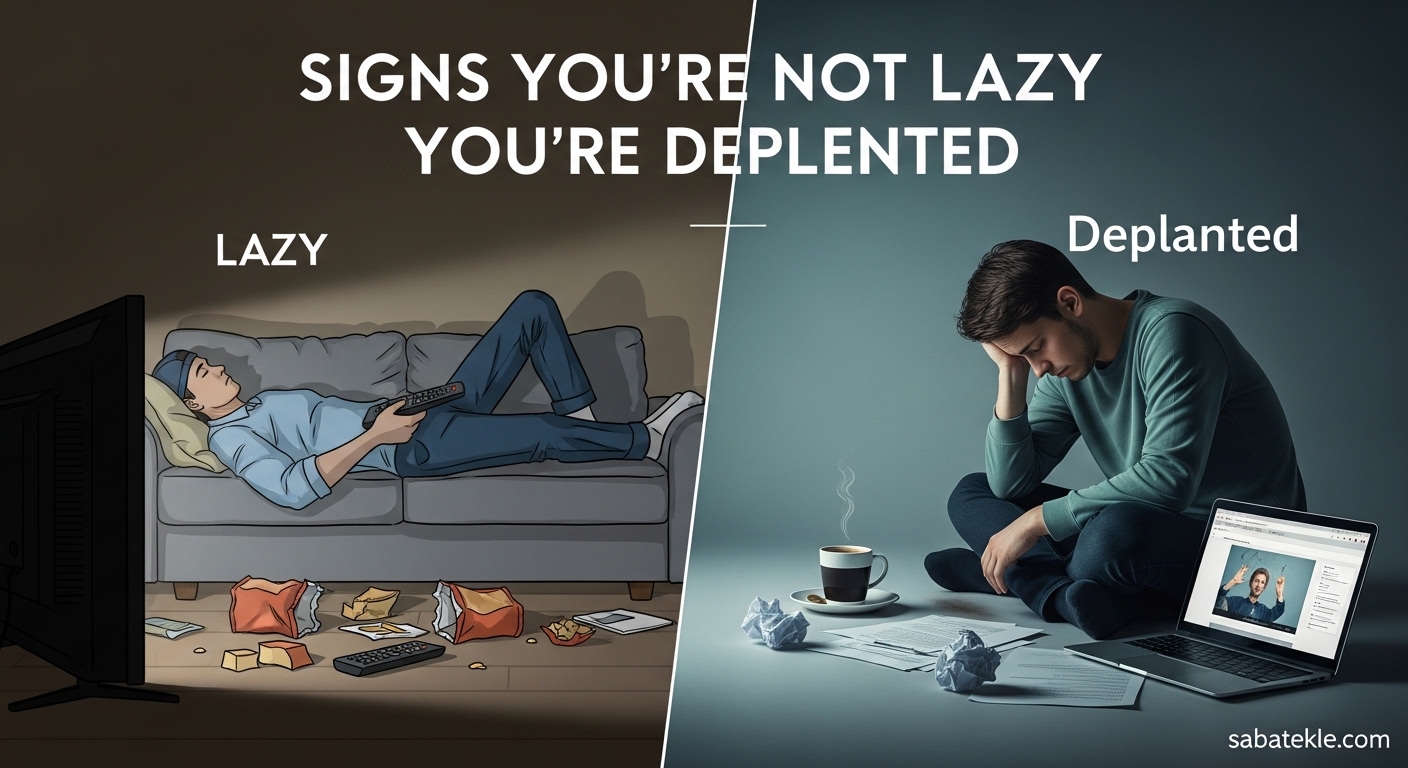
If you have been scrolling through this article at 2 AM, unable to fall asleep even though you are exhausted, let me speak directly to you: what you are feeling right now is probably not laziness. Laziness does not often present as emotional exhaustion, inability to focus, or that heavy dread in your chest that sleep does not fix. What you are experiencing sounds a lot more like depletion, and those two things require completely different solutions.
Our team has analyzed how chronic stress rewires your brain, reviewed clinical research on burnout, and talked to hundreds of people who spent years thinking they were lazy only to discover their nervous system was running on empty. We are going to walk through eight clear signs that distinguish depletion from laziness, explain the neuroscience behind why your brain feels foggy, and give you practical steps to start recovering today.
Table of Contents
The Lazy vs. Depleted Distinction: Why It Matters
Many of us have been taught that willpower is everything. If you just tried harder, you could get things done. But decades of research tell a different story. When your prefrontal cortex is depleted and your amygdala is stuck in overdrive, no amount of discipline will override your biology.
Laziness typically means you can do something but choose not to. Depletion means your cognitive resources are genuinely empty. One is a choice problem. The other is a capacity problem. Understanding the difference is the first step toward actually solving it.
What makes this distinction so important is what happens when you get it wrong. If you think you are lazy, you try to force yourself to work harder. But forcing a depleted system into action only deepens the exhaustion. You end up spinning your wheels, hating yourself for not doing more, while your body actually needs something completely different: permission to stop.
The Neuroscience: What Depletion Does to Your Brain
When you experience chronic stress, your body releases cortisol constantly. This elevation of cortisol impairs your prefrontal cortex, the part of your brain responsible for decision-making, planning, and focus. Meanwhile, your amygdala, the alarm system, stays hyperactive, scanning for threats even when there are none.
Over time, this combination creates what researchers call “cognitive depletion.” You might stare at a simple task like responding to an email and feel genuinely unable to start. Your brain is not being stubborn. It is running out of the fuel it needs to execute.
Dopamine, the neurotransmitter that drives motivation, also drops when you are depleted. This is why anhedonia, the inability to feel pleasure, often accompanies burnout. You intellectually want to do something, but your brain’s reward system is not generating the signal to start.
The technical term for this state is “nervous system exhaustion.” Your parasympathetic system, which handles rest and recovery, becomes suppressed while your sympathetic system, which handles stress, stays dominant. You are essentially stuck in a constant low-grade emergency mode, even when nothing dangerous is happening.
8 Signs You Are Depleted, Not Lazy
1. You Wake Up Tired After a Full Night’s Sleep
If you are sleeping 7-9 hours but still feel exhausted when your alarm goes off, your body is not restoring properly. This is one of the clearest signals of depletion. Forum discussions consistently highlight this symptom: people report sleeping 10-12 hours on weekends and still waking up with that heavy chest feeling.
Real sleep requires nervous system downregulation. When your stress response stays activated, you cycle through lighter sleep stages without reaching the deep restorative phases that actually refresh you. You might technically sleep for eight hours while your body only gets the equivalent of four hours of actual recovery.
2. Small Tasks Feel Overwhelmingly Difficult
You have probably noticed this: a two-minute email somehow feels like climbing Mount Everest. Task paralysis happens when your executive function is compromised. Your prefrontal cortex simply cannot allocate the resources needed to initiate action.
One person in our research described it perfectly: “I would sit there knowing I needed to send a quick Slack message, and it felt like I was trying to move through mud. Not because I did not want to. My brain just would not cooperate.”
This is not about being lazy. This is about your cognitive resources being genuinely insufficient for the task at hand. The problem is neurological, not motivational.
3. You Cannot Enjoy Things You Used to Love
Anhedonia is a clinical term for this, but you probably know it as simply not caring anymore about hobbies, activities, or people that used to light you up. This is not character weakness. It is your brain’s reward pathway being suppressed by chronic stress and cortisol exposure.
The frustration here is real: you intellectually still want to care. You remember loving these things. But the spark is gone, and that absence feels worse than disliking something outright. At least disliking something would generate some response. This emptiness generates nothing.
4. You Are Irritable and Impatient
Depleted nervous systems have less capacity to regulate emotion. Small inconveniences that you would normally shrug off now trigger genuine frustration or anger. Loved ones often notice this first, asking if everything is okay when you feel like you are barely holding it together.
This irritability is not a personality flaw. It is a depletion symptom. Your emotional regulation reserves are empty, and things that should be minor are exceeding your processing capacity. The person snapping at their partner over a dirty dish is not a bad person. They are a depleted person.
5. You Have Unexplained Physical Symptoms
Headaches, digestive issues, muscle tension, getting sick more frequently. These are not imaginary. Chronic stress and cortisol elevation suppress immune function and disrupt digestion. Medical tests often come back normal because the issue is neurological and hormonal, not structural.
Forum participants frequently mention visiting multiple doctors before understanding these physical symptoms were connected to their mental state. One person shared: “I had stomach issues for months. Turns out it was burnout, not a stomach problem.”
These physical symptoms are your body’s way of signaling that something is wrong at the system level. They deserve attention, not dismissal.
6. You Feel Emotionally Numb
Not sad, exactly. Not happy either. Just kind of flat. Emotional numbness often develops as a protective mechanism. If your system is overwhelmed, shutting down emotional responses can feel like survival. But it comes at a cost: you lose access to the feelings that make life feel meaningful.
People describe this as watching their life from outside their body, or feeling like they are acting in a play rather than living. This dissociation is your nervous system trying to protect you from overwhelming input. It is not madness. It is adaptation that has run its course.
7. You Feel Guilt and Shame About Not Being Productive
Guilt about productivity is a hallmark of depletion, not laziness. If you were truly lazy, you probably would not feel bad about it. The shame comes from your brain knowing you should be able to do things and your body refusing to cooperate.
Our team has seen this pattern repeatedly: high-achievers who push themselves hard but feel guilty for not doing more, despite already being at their limits. This guilt is not motivating. It is adding another layer of stress to an already depleted system. Every self-critical thought releases more cortisol, making the exhaustion worse.
8. You Are Stuck in Survival Mode
Survival mode means your nervous system is treating everyday life as an emergency. Small decisions become stressful. Unexpected changes feel catastrophic. You might find yourself micromanaging or feeling unable to delegate because your system is too overwhelmed to trust the process.
For many people, this comes from childhood experiences where staying alert was necessary for safety. But operating in survival mode as an adult, when threats are not actually present, drains your resources relentlessly. You are essentially paying the biological cost of constant vigilance without any of the benefits.
What Is the 42% Rule for Burnout?
Research has identified a threshold sometimes referred to as the 42% rule for burnout. The concept suggests that when you lose approximately 42% of your cognitive resources to stress and recovery demands, you hit a point where additional effort no longer produces results. You are not 42% less effective. You are often completely unable to function at the level you expect.
This is why burnout does not respond to willpower. You cannot push through to the other side by trying harder. The 42% threshold explains why people report sleeping for days after burnout without improvement. Your system needs actual restoration, not more effort.
The good news is that depletion is recoverable. Your brain neuroplasticity means that with proper rest, boundary-setting, and nervous system rehabilitation, you can rebuild cognitive capacity. The exhausted fog does lift. It takes time and intentional recovery, but it does lift.
What to Do When You Recognize These Signs
First, stop trying to push through. That strategy is what got you here. Second, recognize that recovery is not selfish. Your nervous system needs real downtime, not just switching from work to other obligation.
Start with micro-rest periods: five minutes of nothing, no screens, no input. Your system needs moments of actual safety to begin downregulating. Gradually extend these as you can. Some people start with one five-minute break per day and slowly build from there.
Consider what people in our research found most helpful: permission to stop. Permission to not optimize every moment. Permission to rest without earning it first. One forum participant put it simply: “I had to learn that rest was not a reward for productivity. It was a requirement for being human.”
You also need to evaluate what is draining you. Is it work? Relationships? Financial stress? The source of depletion matters because recovery strategies differ depending on what depleted you in the first place. Sometimes the fix is boundary-setting at work. Sometimes it is leaving a relationship. Sometimes it is addressing a medical condition.
When to Seek Professional Help
If you have tried rest and self-care strategies for several weeks without improvement, reach out to a mental health professional. Depletion can sometimes overlap with depression and anxiety disorders that benefit from additional support.
There is no shame in getting help. Your body has been through significant stress. Sometimes working with someone trained in burnout recovery accelerates healing that would take much longer alone. Therapy can give you tools for nervous system regulation and help you identify patterns that keep you stuck.
Medical providers can also run tests to rule out physical causes like thyroid issues, iron deficiency, or vitamin B12 deficiency that might be contributing to your symptoms. Sometimes depletion has a medical component that needs addressing alongside the mental and emotional work.
FAQ
How to know if it’s laziness or burnout?
Laziness typically involves choosing not to do something you can do. Burnout and depletion involve a genuine inability to act despite wanting to, even when you have the time and capability. Key difference: laziness feels like resistance, while depletion feels like paralysis. If rest genuinely does not restore your energy, you are likely dealing with depletion, not laziness.
What is the 42% rule for burnout?
The 42% rule refers to a threshold where approximately 42% of cognitive resources are consumed by stress and recovery demands. Beyond this point, additional effort produces minimal results. Your system hits a wall where willpower cannot override the depletion. Recovery requires actual rest and nervous system rehabilitation, not more pushing.
How do you know if you are depleted?
Common signs include waking up tired despite adequate sleep, small tasks feeling overwhelming, loss of interest in hobbies, irritability, unexplained physical symptoms, emotional numbness, guilt about productivity, and feeling stuck in survival mode. If these resonate with you, you are likely experiencing depletion rather than laziness.
What deficiency causes laziness?
Laziness is not typically a deficiency problem. However, dopamine deficiency can suppress motivation and reward responses, making effort feel impossible even when you want to try. Iron deficiency, B12 deficiency, and thyroid issues can also cause fatigue that looks like lack of motivation. If physical symptoms persist, consider medical testing to rule out nutritional or hormonal causes.
A Direct Message to the Person Reading This
If you have been beating yourself up for being lazy, I want you to hear this: you have probably been doing the best you can with a system that is running on empty. That persistent guilt you feel about not doing more? That is not a productivity meter. That is a sign your nervous system is depleted.
You are not broken. You are not weak. You are not lazy. You are exhausted, and exhaustion requires a different approach than discipline.
The first step is giving yourself permission to rest without earning it. Then, gradually, you rebuild. Not by trying harder. By learning to treat your nervous system as something that needs care, not punishment.
You made it through this article. That tells me you still have fight left. Now it is time to redirect that energy toward your own recovery, not toward endless self-criticism. You have survived whatever brought you here. Your next job is to heal.