
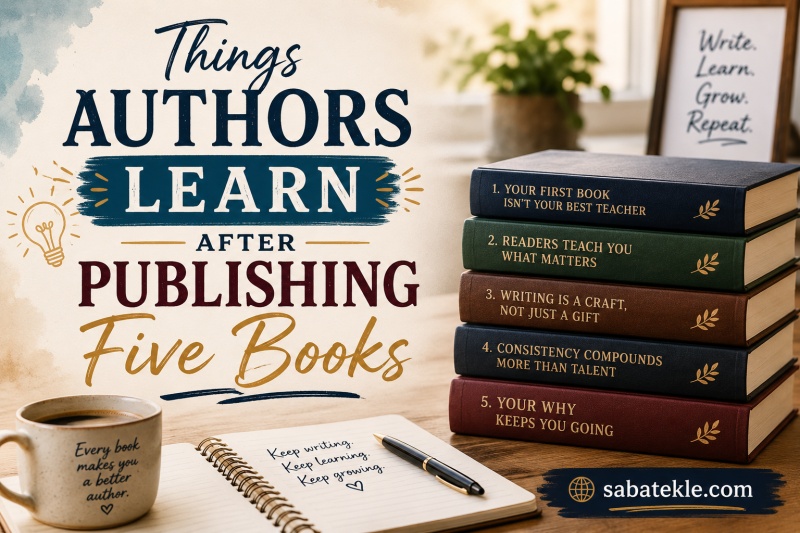
Publishing your first book feels like crossing a finish line. Publishing your fifth feels like finally understanding the race. Somewhere between the excitement of a debut and the steady rhythm of book number five, most authors discover that the things they thought mattered most barely scratched the surface. The things authors learn after publishing five books are not the lessons anyone teaches you in writing workshops or MFA programs. They are earned through late nights, disappointing launch days, royalty statements that make you wince, and the slow realization that writing talent is only the starting point.
The five-book mark is significant. According to surveys from the Authors Guild, the median number of books published by working authors is around four. That means hitting five books puts you ahead of most people who set out to write. But more importantly, five books is enough distance to see patterns you could never spot after one or two. You have lived through multiple launch cycles, weathered bad reviews, experimented with marketing, and watched your backlist either gain momentum or collect dust.
What follows are the seven lessons that surface most consistently when experienced authors reflect on what they wish they had known from the start. These insights come from conversations across writing communities, interviews with multi-book authors, and the hard-earned wisdom of people who kept going when the romanticized vision of authorship gave way to reality.
Table of Contents
Lesson 1: Marketing Is Your Job, Not Your Publisher’s
This is the lesson that hits hardest, and it hits early. Whether you self-publish or sign with a traditional house, the reality is the same: nobody will market your book as hard as you will. Traditional publishers allocate the bulk of their marketing budgets to proven bestsellers and celebrity titles. If you are a debut or mid-list author, your book might get a catalog listing, a few social media posts, and not much else.
After five books, most authors have stopped waiting for someone else to handle discoverability. They have built email lists, cultivated reader communities, and learned which social platforms actually drive sales versus which ones just feel productive. The authors who thrive at the five-book stage are the ones who treat marketing as a skill to develop alongside their writing craft.
One of the most sobering truths shared across writing forums is what experienced authors call the 90/10 rule. Roughly 90 percent of authors do only about 10 percent of the marketing work their books need. The inverse is also true: the 10 percent of authors who commit to consistent marketing see the majority of results. This does not mean spending every waking hour on promotion. It means building sustainable systems: an email newsletter, a content strategy, and a rhythm of reader engagement that compounds with every new release.
If you are on your first or second book, start building your marketing foundation now. Waiting until book five to get serious about audience building means starting years behind where you could be.
Lesson 2: Your Writing Craft Improves Dramatically — But Not How You Think
Most new writers expect their craft to improve through studying technique. Take enough classes, read enough craft books, and the prose will sharpen. That is partly true. But the things authors learn after publishing five books about craft improvement are far more practical and less glamorous than that.
The biggest jump in writing quality happens between books two and three. Book one is often written in a burst of inspiration with limited revision discipline. Book two carries the pressure of proving the first was not a fluke. By book three, most authors have stopped trying to impress and started trying to communicate. The result is cleaner, more confident prose.
Experienced authors also discover that revision is a separate skill from writing — and it is arguably more important. Early-career writers tend to confuse editing with polishing sentences. After multiple books, you learn that real revision means restructuring scenes, cutting beloved chapters, and sometimes rewriting entire sections from scratch. The willingness to cut your own work generously is a craft lesson that only repetition can teach.
Genre exploration plays a surprising role in craft development. Many authors in online writing communities report failing in their ideal genre before succeeding in an unexpected one. Writing romance when you thought you were a thriller writer, or literary fiction when you started in fantasy, forces you to develop different muscles. Even if you return to your original genre, you write it with greater range and versatility.
Perhaps the most useful craft lesson: feedback from strangers is infinitely more valuable than feedback from friends and family. Friends want to encourage you. Strangers want a good book. After five books, most authors have found a small circle of trusted beta readers who give honest, specific, and sometimes painful feedback — and they have learned to welcome it.
Lesson 3: The Financial Realities of Author Income
If there is one topic that catches new authors off guard more than any other, it is money. The romantic image of the full-time author earning a comfortable living from book sales is real for a small minority. For most working authors, the financial picture is more complex and requires realistic planning.
Here is the number that surprises people: most published books sell fewer than 1,000 copies over their lifetime. That is not a typo. According to data from BookScan and various industry surveys, the majority of titles — even those from traditional publishers — fall into this range. The books that sell tens of thousands or hundreds of thousands of copies are outliers, not the norm.
Royalty structures differ dramatically depending on your publishing path. Traditional publishing typically offers royalties between 8 and 15 percent of the cover price on print books and 25 percent on ebooks. Self-published authors using platforms like Amazon KDP can earn between 35 and 70 percent royalties on ebooks, but they bear all production costs. After five books, most authors have run the math enough times to know exactly what they earn per copy sold through each channel.
So how many books do you need to sell to earn $100,000? For a traditionally published author earning roughly $2 per print book sale, that means selling 50,000 copies. For a self-published author earning $4 to $5 per ebook sale, you need roughly 20,000 to 25,000 copies. Neither number is easy to reach, and most authors never hit it with a single title.
The real financial lesson after five books is that your backlist becomes your income engine. Individual titles may spike during launch and then fade, but a catalog of five or more books creates compounding revenue. Readers who discover and enjoy your latest book often go back and buy your earlier titles. Authors who treat each book as an isolated product miss the financial power of having a shelf of interconnected work.
Lesson 4: You Must Think Career, Not Book-by-Book
Books one through three are often written with a single-book mindset: finish this manuscript, get it published, hope it does well. Somewhere around book four or five, a shift happens. Authors stop thinking about individual titles and start thinking about their career as a whole. This is one of the most important things authors learn after publishing five books.
Career thinking means building systems that scale. Instead of creating a new marketing plan from scratch for every launch, experienced authors develop reusable frameworks: email sequences, social media templates, review request workflows, and launch team protocols that improve with each release. The first book launch is exhausting. The fifth should feel like a well-rehearsed process.
Author brand development becomes critical at this stage. After five books, readers and industry professionals start to recognize your name and associate it with a particular style, genre, or perspective. This can be a powerful asset if you have been consistent, or a confusing mess if you have bounced between unrelated genres without explanation. Some authors successfully write across multiple genres, but they do it deliberately, building separate pen names or clear brand architectures rather than confusing their audience.
Release scheduling is another area where career thinking matters. Authors who release too quickly can sacrifice quality and burn out. Authors who wait too long between books lose momentum and reader interest. After five books, most authors have found a sustainable rhythm that balances writing speed, quality standards, and marketing demands without destroying their health or personal life.
And then there is the uncomfortable reality that not every book succeeds equally. After five titles, most authors have experienced the frustration of watching a book they poured their heart into sell modestly while a book they considered lesser unexpectedly found its audience. Learning to accept this inconsistency without letting it dictate your creative choices is a mark of professional maturity.
Lesson 5: Publishing Models Feel Very Different After Five Books
At the start of a writing career, the choice between self-publishing and traditional publishing feels like a one-time decision. After five books, most authors have either switched paths, adopted a hybrid approach, or doubled down on their original choice with eyes wide open.
Self-published authors often discover that their advantages compound with each book. Control over pricing, cover design, release timing, and marketing strategy builds institutional knowledge that pays dividends across a growing catalog. The learning curve is steep for book one, but by book five, many self-published authors have become skilled publishers in their own right.
Traditionally published authors, meanwhile, often become more critical of their contracts after multiple experiences with rights management, royalty reporting, and publisher marketing decisions. Learning what you can and cannot control in a traditional deal is one of the painful but necessary things authors learn after publishing five books. Issues around audiobook rights, foreign rights, and reversion clauses become real concerns rather than abstract contract language.
This is also the stage where audiobook production enters the conversation. Producing an audiobook can cost anywhere from $2,000 to $10,000 depending on length, narrator quality, and production method. After five books, many authors have either invested in professional narration or explored newer AI-assisted voice technology as a cost-effective alternative. The audiobook market continues to grow year over year, making it an increasingly important revenue channel.
Hybrid publishing — combining traditional deals for some titles with self-publishing for others — emerges as a realistic strategy for many five-book authors. This approach lets authors leverage the credibility and distribution of traditional publishing where it matters while maintaining control and higher royalties on other projects.
Lesson 6: Reader Relationships Change Everything
Finding your true audience takes multiple books. Many authors report that their ideal readers did not show up until book three, four, or even five. Early readers are often friends, family, and curious browsers. The readers who stick around and become genuine fans tend to emerge once an author has published enough work for people to recognize a pattern and develop trust.
Superfans — those dedicated readers who buy everything you write, leave reviews, and recommend your work to friends — typically start appearing around the third or fourth book. These readers are the foundation of a sustainable author career. They are worth more than any single advertising campaign or social media strategy because their engagement compounds over time.
Building direct communication with readers becomes non-negotiable. After five books, experienced authors understand that relying solely on social media algorithms or retailer platforms to reach readers is risky. An email newsletter with even a modest subscriber count gives authors a direct, owned channel to announce new releases, share behind-the-scenes content, and maintain relationships between books.
And then there is the matter of negative reviews. Every author dreads them. But after five books, most experienced authors have developed genuine immunity to bad reviews — or at least a functional coping mechanism. You learn that a one-star review says more about the reader than the book. You learn that even your favorite published authors have terrible reviews. You learn that the only reviews worth worrying about are the ones that point out a specific, recurring issue in your craft.
Lesson 7: No One Cares — And That Is Liberating
This might sound harsh, but it is possibly the most freeing lesson an author can internalize. The world does not owe you attention, recognition, or success. Most people will never hear of you. Most readers will never find your books. The literary establishment will probably not celebrate your work. And once you accept that, something remarkable happens.
You stop writing for approval and start writing for the right reasons. Authors who have published five or more books consistently report that their relationship with writing changed for the better once they stopped chasing external validation. The pressure to impress agents, publishers, critics, and the market gives way to a quieter, more sustainable motivation.
This lesson is especially important for managing the comparison trap. In online writing communities, it is easy to watch other authors announce book deals, hit bestseller lists, or land speaking engagements while your own progress feels slow. After five books, most authors have learned that comparing your chapter one to someone else’s chapter twenty is not just unhelpful — it actively damages your productivity and creativity.
Sustainability becomes the priority. Burning out after two books helps no one. Building a writing practice that can sustain you across ten, fifteen, or twenty books is more valuable than any single launch success. That means setting realistic expectations, protecting your writing time, and giving yourself permission to take breaks when you need them.
The authors who last in this industry are not necessarily the most talented. They are the ones who found a way to keep going when the initial excitement faded and the reality of the work settled in.
Frequently Asked Questions About the Author Journey
What is the 90/10 rule for authors?
The 90/10 rule for authors refers to the observation that roughly 90% of authors do only about 10% of the marketing work their books actually need. The remaining 10% of authors who commit to consistent, strategic marketing see the majority of results. This includes building an email list, engaging with reader communities, and maintaining a regular promotional presence across multiple channels.
How many books do you have to sell to make $100,000?
The answer depends on your publishing path and royalty rate. A traditionally published author earning roughly $2 per print book needs to sell about 50,000 copies to reach $100,000. A self-published author earning $4 to $5 per ebook sale needs approximately 20,000 to 25,000 copies. Most authors reach this income level through a backlist of multiple books rather than a single title, making catalog size and reader retention critical factors.
At what age do writers peak?
There is no single peak age for writers. Research and anecdotal evidence show that many authors produce their best work across a wide age range, from their 30s through their 70s. Unlike some creative professions, writing benefits from accumulated life experience, emotional maturity, and sustained craft development. Many successful authors published their breakthrough books well into their 40s, 50s, or beyond.
What is the next step after publishing a book?
After publishing a book, the next steps include: actively marketing the book through your email list, social media, and reader communities; gathering early reviews to build social proof; analyzing what worked and what did not in your launch process; beginning work on your next book to maintain momentum; and evaluating your publishing strategy for future titles. The most successful authors treat each book launch as a learning opportunity that informs their next project.
How long does it take to write and publish five books?
The timeline varies widely depending on the author. Fast-paced genre writers releasing shorter works may publish five books in two to three years. Authors writing longer, more complex works or working with traditional publishers may take five to ten years to reach five books. On average, authors who publish consistently reach the five-book mark in about four to six years. The key factor is not speed but sustainability — building a pace you can maintain without burning out.
What Five Books Really Teaches You About Writing
Looking back at these lessons, a clear pattern emerges. The things authors learn after publishing five books are less about writing technique and more about building a sustainable practice around your writing. You learn that marketing is a non-negotiable skill. You discover that your craft improves through revision, genre exploration, and honest feedback more than through studying theory. You come to terms with the financial realities of authorship and learn to build income through backlist momentum rather than chasing individual bestseller moments.
You learn to think like a career author, not a one-book wonder. You understand that publishing models have real trade-offs that look different after multiple experiences. You build genuine relationships with readers who stick with you across titles. And, perhaps most importantly, you learn that the freedom to write without needing the world to care is the most powerful creative advantage you will ever have.
Five books is not an endpoint. It is the place where most authors finally stop guessing and start operating with clarity. If you are on your first or second book and wondering whether the effort is worth it, the answer from those who have reached this milestone is consistent: the lessons are hard, the work is real, and the growth is worth every frustrating, illuminating step.
The authors who make it to book five are not special. They are simply the ones who decided that quitting was not an option. That decision, repeated daily through doubt and rejection and mediocre royalty statements, is the real lesson underneath all the others.