
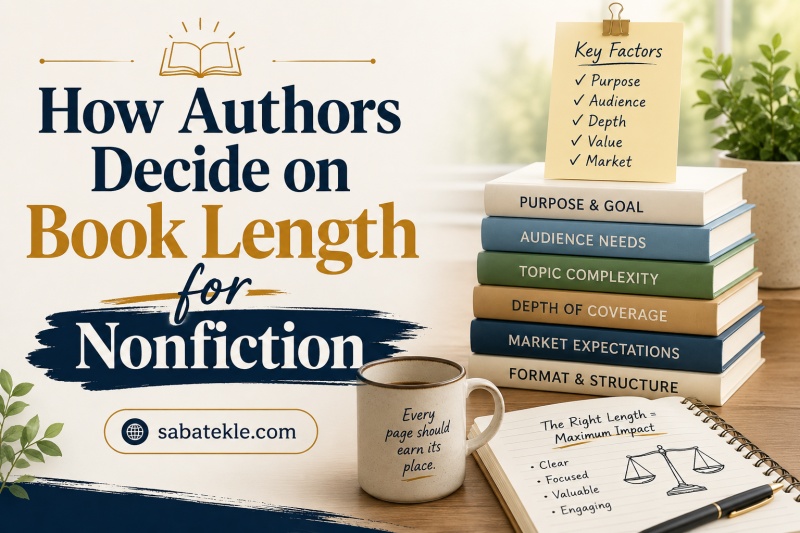
When we set out to write a nonfiction book, one of the first questions that surfaces is simple but weighty: how long should it be? Authors spend weeks, months, or even years wrestling with this decision. Some fear being too short and seeming unprepared. Others worry about padding content to hit arbitrary numbers. The truth is, how authors decide on book length for nonfiction involves a surprisingly practical process that balances reader expectations, publishing requirements, and the actual scope of what you want to say.
This decision matters more than many first-time authors realize. Your book length affects pricing, reader perception, and whether your work fits industry standards for your chosen publishing path. Get it right and your book feels complete and professional. Get it wrong and you either leave readers wanting more or lose them in unnecessary filler. Let us walk through exactly how this decision gets made.
Table of Contents
Word Count Guidelines: What Industry Standards Actually Say
Most nonfiction books fall between 50,000 and 75,000 words. This range represents what traditional publishers expect for a standard trade paperback. At roughly 250 words per page, that translates to about 200-300 pages, which feels substantial without being overwhelming. This sweet spot exists because it gives authors enough room to explore a topic thoroughly while keeping production costs manageable and reader attention spans in mind.
Shorter works exist and thrive. Books in the 25,000-40,000 word range (100-160 pages) work exceptionally well for focused topics, how-to guides, and quick-read business books. These work particularly well for self-publishing where you control the final product. The common fear that shorter books seem less valuable only holds weight if the content itself feels thin. A well-designed 30,000-word book with strong content outperforms a padded 80,000-word book every time.
Longer nonfiction works, pushing past 80,000 words, typically serve comprehensive reference books, memoirs with complex narratives, or academic works. If your book aims to be the definitive guide on a subject, you may naturally need more space. However, crossing 100,000 words raises production costs and signals to publishers that the market may be narrower. Most readers seeking practical guidance actually prefer books they can finish in a few sitting rather than multipart epics.
The Two Publishing Paths: How Your Route Shapes Length
Traditional Publishing Expectations
Traditional publishers operate within strict parameters. Their production budgets, retail shelf allocations, and reader expectations all influence what they consider acceptable. When you submit to a legacy publisher, they typically expect nonfiction manuscripts between 50,000 and 75,000 words. Books shorter than 45,000 words often face skepticism during acquisition because publishers worry readers will feel shortchanged. Books significantly longer than 80,000 words face higher scrutiny because production costs rise exponentially with page count.
This does not mean you cannot deviate. Highly credentialed authors with established platforms sometimes negotiate longer manuscripts. Niche topics with devoted audiences occasionally allow flexibility. But for first-time authors or those without significant leverage, staying within the standard range dramatically improves your chances of landing an agent or getting a fair publishing offer. The industry expectations exist because they reflect what has sold consistently over decades.
Self-Publishing Flexibility
Self-publishing throws those numbers out the window, and that freedom surprises many new authors. In self-publishing, your book length is entirely your decision. Some of the most successful nonfiction books in the Amazon marketplace run between 15,000 and 30,000 words. Readers who purchase these expect quick, actionable content delivered fast. They evaluate books on value per dollar rather than page count.
This flexibility cuts both ways. You can write exactly what your topic needs without padding. But you also face the challenge of making a shorter book feel substantial and professionally produced. Book design, formatting, and strategic content organization help significantly. A 25,000-word book with excellent layout, chapter summaries, and actionable takeaways can feel more complete than a poorly organized 60,000-word manuscript. Self-published authors who understand this win more often than those who try to mimic traditional publishing page counts.
How Authors Actually Decide: A Decision Framework
Here is where most articles stop listing factors and leave you hanging. Let us give you the actual process. After analyzing how successful authors make this decision, a clear framework emerges. You work through four steps in sequence, and each one shapes your final word count.
Step 1: Define Your Book’s Purpose
Ask yourself what single outcome you want readers to achieve. A book meant to establish you as an industry thought leader has different length requirements than one designed as a practical training manual. Thought leadership books benefit from 50,000-75,000 words because depth signals expertise. Training manuals can succeed with 20,000-40,000 words if every chapter delivers immediately applicable skills. Your purpose determines scope, and scope determines length.
Step 2: Know Your Audience
Who will buy your book, and what do they expect? Business readers shopping on Amazon often prefer 150-200 page books they can consume on a flight. Academic readers expect comprehensive coverage running 60,000+ words. Memoir readers settle in for longer journeys but also appreciate concise storytelling. Survey your potential readers before setting your word count. Their expectations matter more than arbitrary industry standards.
Step 3: Match Scope to Length
Outline your content. Count the chapters and estimate realistic word counts for each. If your natural outline produces 35,000 words but you feel obligated to reach 60,000, that gap signals a problem. Either narrow your scope to match 35,000 words or broaden your approach to genuinely need 60,000. Forcing content to hit numbers never works. Readers sense the difference between organic depth and padded filler.
Step 4: Adjust for Your Publishing Route
Your intended path determines how strictly you follow the numbers. Traditional publishing requires staying within 50,000-75,000 words to be competitive. Self-publishing gives you permission to write exactly what your topic demands, whether that is 20,000 or 80,000 words. This final adjustment aligns your creative vision with market realities.
Genre-Specific Considerations
Book length expectations vary significantly by genre, and understanding these differences prevents costly mistakes. Business and leadership books typically range from 45,000 to 65,000 words. Readers in this space want actionable frameworks, case studies, and clear takeaways. They rarely need exhaustive research documentation, which keeps these books tighter and more focused.
Self-help and personal development books follow similar patterns, usually landing between 40,000 and 60,000 words. The most successful books in this category deliver transformation in under 200 pages. Readers want quick wins and implementable strategies rather than theoretical deep dives. Pacing matters enormously in this genre, and shorter, well-structured books outperform bloated alternatives.
Memoirs and narrative nonfiction allow more flexibility, often ranging from 60,000 to 90,000 words. These books carry readers through extended journeys, and length correlates with narrative complexity. However, tight editing remains essential. Literary agents consistently report that most memoirs get rejected for being too long rather than too short. Every extra word must earn its place in these manuscripts.
Academic and reference nonfiction operates under different rules entirely. These books aim for comprehensive coverage, regularly exceeding 80,000 words and sometimes surpassing 150,000. If you write in this space, your audience expects exhaustive treatment. Length signals authority in academic circles, and publisher expectations reflect this.
Common Misconceptions About Book Length
Forum discussions reveal persistent myths that hurt first-time authors. The most damaging misconception involves padding. Many authors believe they must artificially extend their content to hit industry numbers. This leads to rambling introductions, redundant examples, and chapters that repeat themselves. Readers notice immediately. Content quality matters infinitely more than hitting a specific count.
Another harmful myth suggests short books lack credibility. Self-publishing success stories routinely disprove this. Authors who deliver focused, valuable content in 25,000 words build loyal audiences faster than those who produce 80,000-word勉强读完 tomes. Perception follows value. A short book that changes how someone works gets recommended more often than a long book that bogs down with unnecessary content.
New authors also worry excessively about pricing implications of length. While it is true that print books require minimum page counts for physical production, ebook pricing operates independently of word count. Readers evaluate ebook value based on the transformation offered, not the page count. A 20,000-word ebook priced at $19.99 succeeds when it delivers outcomes worth that investment.
Finally, do not assume your first draft establishes your final length. Many authors discover mid-writing that their natural scope produces more or fewer words than expected. This discovery is normal and healthy. You adjust. If your draft runs 90,000 words, you tighten and edit until it fits your target. If it runs 35,000 words and feels complete, you do not force expansion. Flexibility in the writing process matters more than rigid adherence to numbers.
FAQs
What’s a good length for a nonfiction book?
Is 30,000 words enough for a nonfiction book?
Yes, for self-publishing. 30,000 words (about 120 pages) is sufficient if your topic is narrowly focused and delivers value. Traditional publishers typically expect 50,000+ words, but self-publishing gives you flexibility.
Is 20,000 words enough for a nonfiction book?
20,000 words works for micro-books or focused guides, especially in self-publishing. However, readers may perceive it as less comprehensive. Keep it if your content is truly complete at that length.
Is a 1,500 word chapter too short?
Chapter length varies widely. Most nonfiction chapters range from 2,000 to 5,000 words. 1,500 words can work if the chapter covers one focused concept. Consistency matters more than exact length.
What is the 90/10 rule for authors?
The 90/10 rule suggests spending 90% of effort on content quality and 10% on marketing/promotion. Applied to book length, it means focus on delivering complete, valuable content rather than padding for arbitrary word counts.
Understanding how authors decide on book length for nonfiction comes down to matching your content scope with your audience expectations and publishing path. The framework works: define purpose, know your readers, match your scope, then adjust for your route. Trust the process. Your first book does not need to be perfect in length, only complete in delivering what you promised.
The authors who succeed do not agonize over hitting arbitrary numbers. They write until their content feels finished, then edit ruthlessly to keep only what serves the reader. That approach produces books people recommend, not books that collect dust on shelves because they felt obligated to meet some number that never mattered to anyone actually reading the work.
Your book length decision starts now. Work through the framework. Write the content your topic genuinely needs. Adjust based on what emerges naturally during the writing process. You will recognize completion when it arrives, and that recognition matters more than any guideline you find online.