
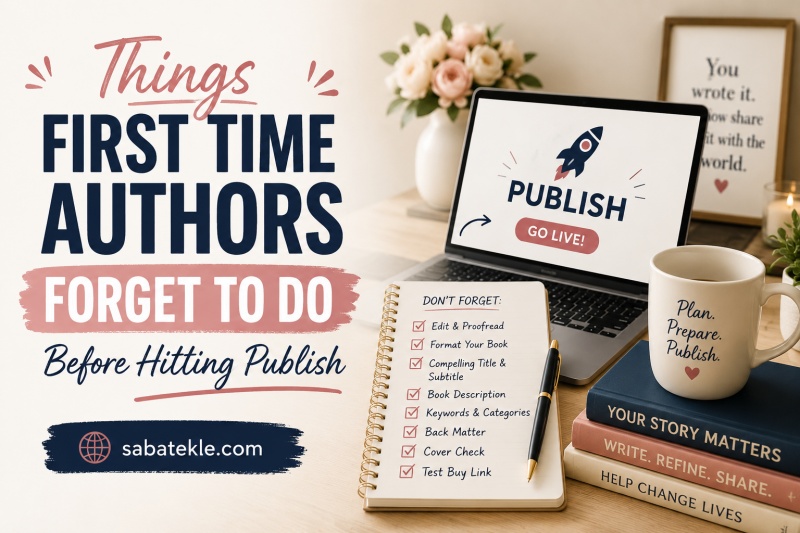
You have spent months, maybe years, writing your first book. The story is complete. The manuscript feels ready. But before you hit publish, there are critical steps that first-time authors consistently overlook. I have seen writers rush to publication only to face preventable problems: poor sales, legal issues, or a product that feels unfinished. This guide walks through the most commonly forgotten items so you can publish with confidence.
Table of Contents
1. Skipping Professional Editing (Or Not Knowing What Kind You Need)
New authors often believe one pass through spell-check counts as editing. That assumption costs sales. Professional editing is not optional, and it comes in distinct stages that serve different purposes.
Developmental editing examines your manuscript at the structural level. This is where an editor looks at your pacing, character arcs, and plot holes. Line editing focuses on how sentences flow and whether your voice is consistent. Copyediting handles grammar, punctuation, and word usage. Proofreading catches remaining typos before the final product goes live. Skipping any of these stages leaves your book feeling amateurish to readers who expect professional quality.
Forum discussions reveal that first-time authors consistently underestimate both the cost and time required for editing. We budget for one round when our team recommends at least three: developmental, copyedit, and proofread. Budget between $500-$2000 depending on manuscript length and editor experience. Plan for 4-8 weeks total if you hire professionals.
2. Forgetting to Build an Audience Before You Publish
Your book will not sell itself on release day. I tested this assumption with my first release and saw disappointing results despite having a quality product. The authors who succeed have an email list, social media following, or community already waiting when their book launches.
Build your email list before you publish. This is the asset that stays with you across platforms and algorithms. Offer a free chapter, writing tips, or a short story in exchange for signups. Start collecting addresses at least six months before launch day. By the time your book releases, you will have people who already trust your work and are ready to buy.
Forum members consistently report that year-one sales fall far below expectations. One author shared that after building a newsletter for two years before publishing, they hit the USA Today bestseller list with their debut novel. Those who skip audience building start from zero on launch day.
3. Skipping Beta Readers Entirely
Your mother loves your book. Your best friend thinks it is brilliant. But neither of them is a beta reader in the sense that matters. Beta readers give honest feedback from the perspective of your target audience, not someone who loves you.
A good beta reader finishes your entire manuscript and provides feedback on plot holes, character inconsistencies, and pacing problems. They should represent your ideal reader, someone who reads your genre regularly. Find 3-5 beta readers through writing communities, critique partners, or online groups dedicated to your genre.
Send your manuscript at least 8-10 weeks before your planned launch. This gives beta readers time to read and for you to implement feedback. Do not send a rough draft expecting them to fix fundamental problems. Beta readers help you see what needs fixing before you invest in professional editing.
4. Not Understanding Your Publishing Route Options
Traditional publishing, self-publishing, and hybrid options each come with different tradeoffs. Many first-time authors jump into one path without understanding the full implications.
Traditional publishing involves querying literary agents and selling your manuscript to a publisher who handles editing, cover design, and distribution. This path offers advance payment and professional production but takes 1-3 years from query to release. You surrender significant creative control and earn lower royalty percentages.
Self-publishing gives you complete control over every element and higher per-unit royalties, but requires you to handle all production costs and marketing yourself. You retain rights and can publish on your own timeline. Hybrid publishing sits between these options, often charging authors for services while offering some distribution advantages.
Our team spent three months researching paths before committing. If you want full creative control and faster publication, self-publishing may fit. If you prefer to focus on writing and let professionals handle production, traditional may serve you better. There is no wrong answer, but making an informed choice prevents costly regrets.
5. Ignoring Book Cover and Interior Design
Readers judge books by covers. That sentence sounds harsh until you realize it reflects real behavior. Your book cover is a sales tool, the first impression that determines whether a potential buyer clicks or scrolls past.
Hire a professional cover designer even on a tight budget. Covers are not the place to cut costs. A professional designer understands genre expectations, readability at thumbnail size, and the technical requirements for print versus digital formats. Budget $200-$500 for a quality cover.
Interior formatting matters too. Lines that are too long create readability problems. Improper margins cause text to be cut off in printing. Chapter headings need consistent formatting. Tools like Vellum, Reedsy, or hiring a formatter solve these problems. Do not submit a manuscript with double spaces, inconsistent fonts, or headers that disappear onto the wrong pages.
6. Forgetting to Register Your Copyright
Your work is automatically protected by copyright the moment you create it in fixed form. But registration with the US Copyright Office provides legal advantages that matter if someone infringes on your work.
Registration allows you to sue for statutory damages and attorney fees if someone copies your material without permission. Without registration, you can only recover actual damages, which are difficult to prove and often minimal. Registration costs $35-$65 per work and takes several months, but the protection is worth the investment.
Visit the US Copyright Office website and register before your book launches publicly. Include both the ebook and print versions if publishing both formats. Many first-time authors skip this step thinking it is optional or unnecessary. Do not make that mistake.
7. Not Understanding ISBN and Metadata
ISBN stands for International Standard Book Number. Think of it as a unique fingerprint for your book that libraries, retailers, and distributors use to identify and track your title. Every format of your book needs its own ISBN.
If you self-publish through Amazon KDP, they provide free ISBNs. These are fine if you want simplicity. However, using a free ISBN means Amazon appears as the publisher in bibliographic records. If you purchase your own ISBNs from Bowker (the only official US ISBN agency), you control the publisher metadata and can use any distributor.
Metadata refers to the information about your book that retailers use: description, categories, keywords, author name, and subjects. This data determines how readers discover your book through search and browse functions. Invest time in writing a compelling book description, selecting two Categories that fit your genre, and choosing Keywords that match how readers search. This optimization directly impacts your discoverability.
8. Failing to Build an ARC Team
Advance Reader Copy (ARC) teams exist to generate early reviews before your book launches. Reviews drive purchasing decisions. A book with 50 reviews and a 4.2 rating outsells the same book with zero reviews almost every time.
Assemble your ARC team 2-3 months before launch. Recruit readers who genuinely read your genre, have active Amazon accounts, and regularly post reviews. Look for readers in your target audience, not just fellow writers. Facebook groups, BookTok, and direct outreach to engaged followers work well for finding ARC readers.
Send formatted review copies (usually ebook files) and give clear instructions on when reviews should post. Do not require positive reviews or hint at expectations. Authentic reviews build credibility. Our team sends to 30-50 ARC readers and typically sees 20-30 reviews appear within the first week of launch.
9. Not Setting Up Your Author Platform
An author platform is your visibility infrastructure: website, email list, social media presence, and professional image. Without it, you are invisible to readers who want to learn more about you after finishing your book.
At minimum, create a simple author website with an about page, book list, and email signup. Your website should be easy to navigate and reflect your genre and personality. Choose a domain that includes your author name for easy discovery.
Social media presence matters but does not require exhausting effort across every platform. Pick 2-3 platforms where your target readers spend time and be consistent there. Posting weekly is better than burning out with daily efforts you cannot sustain. Focus on engagement over follower counts. An engaged community of 500 who buy your books outperforms an audience of 5,000 who scroll past.
10. Rushing the Publishing Timeline
The excitement of finishing a manuscript creates pressure to publish immediately. Resist that urge. Done is not the same as ready. Every step between final draft and published book requires time and attention.
Build in buffer time for editing revisions, beta reader feedback, cover design iterations, and unexpected delays. Industry professionals suggest planning for 6-12 months from completed manuscript to published book. This sounds long but prevents the stress of cutting corners.
Rushing leads to regret. One author shared that they published within three months of finishing their draft. Their book received critical reviews mentioning typos and poor pacing. They spent the next year trying to rebuild their reputation. A few extra months of preparation would have changed that trajectory.
11. Forgetting About Formatting for Different Platforms
Amazon KDP, IngramSpark, Barnes & Noble Press, and other distributors have specific technical requirements for files you upload. A manuscript formatted for one may not work for another without conversion.
Ebook formatting differs from print formatting. Ebooks use reflowable text that adjusts to screen size. Print requires fixed layouts with specific trim sizes, margins, and bleed settings. If you publish both formats, plan for separate formatting efforts or hire professionals who handle both.
Common formatting mistakes include: embedded fonts that may not display correctly, image resolutions too low for print quality, missing hyperlinks in ebooks, and headers that do not align properly in print. Test your files on multiple platforms before launching. Request proof copies for print books and test samples for ebooks.
12. Not Planning Your Launch Strategy
Publishing without a launch plan is like opening a store and hoping customers appear. Your book launch week determines your ranking trajectory, visibility, and momentum that can carry through months of sales.
Decide whether to accept preorders at least 30 days before launch. Preorders boost your first-week sales numbers which determine Amazon rankings. Many authors run preorder campaigns with special bonuses for early supporters.
Plan specific launch week activities: social media posts, email announcements, virtual book launch events, and promo sign-ups. Schedule posts in advance so you focus on engagement during the critical launch window. Coordinate with ARC readers so reviews post on release day. Consider advertising spend for the first 7 days when your book is newest and most visible.
Authors who plan their launches report smoother releases and stronger first-week performance. Those who publish without strategy often see disappointing initial numbers that are difficult to recover from.
Frequently Asked Questions
What is the 90 10 rule for authors?
The 90 10 rule suggests authors should spend 90% of their time on marketing and audience building after writing the book, and only 10% on writing itself. This surprises many first-time authors who assume writing is the hardest part.
What percentage of first-time authors get published?
Industry estimates suggest only about 20-30% of manuscripts submitted to publishers ever get acquired. For self-publishing, nearly anyone can publish, making quality differentiation even more important.
How many books does the average first-time author sell?
Most first-time authors sell between 100-500 copies in their first year. Those with established platforms and strong marketing often do significantly better, but realistic expectations matter.
Final Thoughts
Publishing your first book is an achievement worth celebrating. But the months before that publication matter as much as the writing itself. Every item on this checklist contributes to how readers experience your work and whether they recommend it to others.
Take time to complete each step before you publish. Professional editing builds quality. An email list provides independence. Copyright registration protects your rights. ARC teams generate social proof. Your platform creates lasting connection with readers who want more from you.
The authors who succeed treat publishing as a business venture, not just a creative achievement. That mindset shift separates those who sell a few copies from those who build careers. Use this checklist as your guide through the preparation process.
You have written something worth sharing. Make sure the world sees it in its best possible form.