
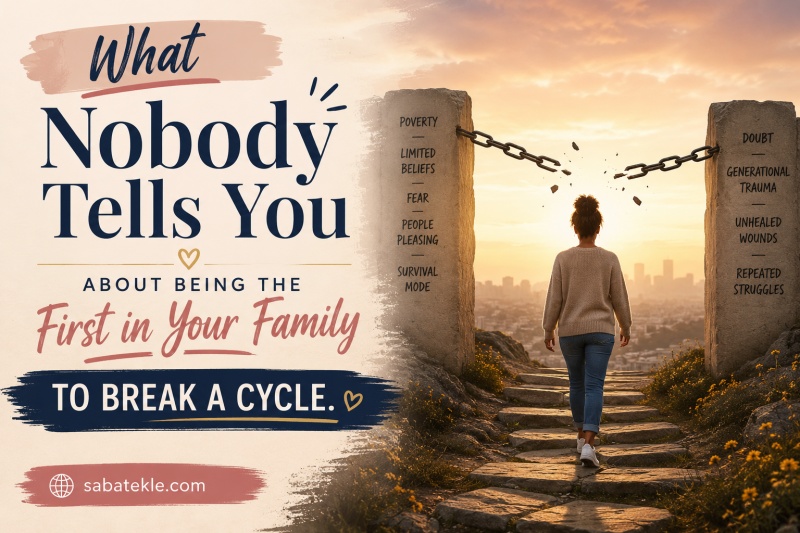
There’s a specific kind of loneliness that comes with being the first in your family to break a cycle. It’s not the loneliness of being physically alone. It’s deeper than that. It’s the isolation of seeing patterns nobody else wants to acknowledge. It’s standing at a threshold between who you were raised to be and who you’re choosing to become, knowing that crossing it might mean crossing out of your family’s good graces entirely.
Here’s what nobody tells you about being the first in your family to break a cycle: it will cost you more than you expect. It will cost you relationships, comfort, and the illusion of belonging. You’ll be called selfish, difficult, ungrateful. You’ll question yourself daily. And at the same time, you’ll be building something your future self will thank you for every single day.
I’ve spent the last decade working with cycle breakers, healing from my own generational patterns, and studying family systems theory. What follows is the truth about what this journey actually looks like, the costs nobody advertises, and the strategies that actually work when you’re navigating territory your family never mapped.
Table of Contents
What It Actually Means to Be the First to Break a Family Cycle
A cycle breaker is someone who recognizes dysfunctional patterns running through their family and consciously chooses not to pass them forward. These patterns might be emotional, relational, financial, or behavioral. They could involve addiction, abuse, neglect, codependency, or simply ways of relating that leave everyone walking on eggshells.
Being the first means exactly that: you are the pioneer in your bloodline. Nobody before you has done this work. There is no family roadmap. No one has modeled healthy boundaries, emotional regulation, or secure attachment. You’re building the plane while flying it, and the turbulence gets intense.
Most people think breaking cycles is about making better choices. That’s only half the story. The other half is unlearning. You have to unlearn the survival strategies that kept you safe as a child but keep you trapped as an adult. You have to unlearn the belief that love equals suffering, that boundaries are selfish, that your worth depends on keeping other people comfortable.
The Disorientation Nobody Warns You About
Nobody talks about how disorienting it is to be the first. The first to make it out. The first to unlearn survival. The first to say no.
When you start breaking cycles, you lose your sense of identity within the family system. For years, maybe decades, you had a role. The peacemaker. The responsible one. The black sheep. The caretaker. When you stop playing that role, the system panics. And you panic too, because who are you if you’re not who your family needs you to be?
This disorientation extends beyond family gatherings. It affects your friendships, your romantic relationships, your work life. You start noticing toxic patterns everywhere because your eyes are finally open. You see dysfunction in places you once thought were normal. It’s like upgrading from a black-and-white TV to high definition, except the show is your entire life, and suddenly you can see every flaw in stunning clarity.
The isolation hits hardest here. You can’t unsee what you’ve seen. You can’t unlearn what you’ve learned. And the people around you, the ones still playing their roles, often can’t understand why you’re changing. They liked the old you better. The old you made them comfortable.
Why Cycle Breakers Get Cast as the Family Villain
Here’s the brutal truth about family systems: they crave homeostasis. Family systems theory teaches us that families operate like living organisms, seeking balance and stability. Everyone has a role. Everyone plays their part. When one person stops playing, the system sees them as a threat.
When you set boundaries, you disrupt that homeostasis. When you refuse to participate in old patterns, you force the system to look at itself. And looking at dysfunction is painful. It’s much easier to label you as the problem than to examine generations of hurt.
Families have a playbook of tactics to pull you back in. Understanding them gives you power:
- Weaponized hurt feelings: “I can’t believe you would do this to your own mother.” The goal is to make your boundary feel like an attack.
- The “you’ve changed” accusation: As if growth is a crime. As if staying exactly who you were at fifteen is the goal.
- Recruiting allies: Getting siblings, aunts, uncles involved to pressure you. Making your boundary a family-wide crisis.
- Revisionist history: Suddenly your childhood was perfect. Everyone was happy. You’re imagining things. This is gaslighting, plain and simple.
- The martyr narrative: “After everything I’ve sacrificed for you.” Making your boundary about their suffering, not your needs.
- Conditional love withdrawal: Pulling affection and approval until you fall back in line.
You’re not the villain. You’re just the first person brave enough to hold up a mirror.
The Hidden Emotional Costs Nobody Talks About
The cognitive dissonance is brutal. Part of you knows you’re doing the right thing. Part of you is screaming that you’re a terrible daughter, son, sibling. Your nervous system is confused because safety used to mean compliance, and now you’re choosing the opposite.
There’s grief that doesn’t get discussed. The grief of realizing you’ll never have the family you needed. The grief of accepting that some people will never see you, never understand you, never choose healing over comfort. You mourn the parents you wish you’d had while navigating relationships with the parents you actually got.
The exhaustion is physical. Being the one who sees the patterns means you’re constantly managing your own reactions while everyone else acts on autopilot. You’re doing emotional labor nobody acknowledges. You’re holding boundaries that everyone tests. You’re the designated grown-up in a family full of adults.
And there’s the pressure. The weight of being the “first.” If you fail, does that mean it was impossible? If you struggle, does that mean you should go back? You’re not just working for your own healing, you’re carrying the hope of what could be for everyone who comes after you.
The Financial Reality of Breaking Cycles
Here’s something competitors rarely address: breaking cycles costs money. Real money. Money you might not have when you’re just starting out.
Therapy is expensive. Good therapy, the kind that actually helps you untangle generational patterns, runs $100-$300 per session. Insurance often doesn’t cover it adequately. You might need years of support. You might need multiple therapists before you find the right fit.
There’s also the cost of lost family support. Many cycle breakers lose financial safety nets. Parents who might have helped with a down payment or an emergency fund withdraw that support once boundaries are set. You’re choosing long-term health over short-term security.
Self-help resources add up. Books, courses, workshops, retreats. These aren’t luxuries when you’re trying to unlearn a lifetime of patterns. They’re necessities that drain your bank account.
The pressure of being the “first” extends to finances too. You’re not just working for a paycheck. You’re working for generational change. You might be the first to build real savings, the first to own a home, the first to break poverty cycles. That weight sits on your shoulders every time you check your bank account.
How to Navigate Family Reactions Without Losing Yourself
When families react to boundaries, they tend to escalate. Knowing the escalation ladder helps you hold steady.
First comes the testing: “Are you serious about this boundary?” Small violations to see if you’ll enforce it.
Then the pleading: “Can’t you just make an exception? Just this once?”
Then the anger: “How dare you do this to us.”
Then the silence: The cold shoulder designed to make you come crawling back.
Your job is to hold the line through all of it.
Scripts help when your nervous system is screaming. Here are some that actually work:
For weaponized hurt: “I understand you’re upset. My boundary stands.”
For revisionist history: “We remember things differently. I’m not going to debate my experience.”
For the martyr narrative: “I hear that you feel hurt. That doesn’t change what I need.”
When they recruit allies: “I’m happy to discuss this with you directly. I won’t engage through third parties.”
Disengagement is a tool, not a failure. Sometimes the only way to hold a boundary is to remove yourself from the situation. Leave the room. End the call. Skip the holiday. You’re allowed to prioritize your peace over family peace.
Finding your people outside the family system matters more than most cycle breakers realize. You need witnesses who see you clearly. Friends who understand what you’re doing. Communities of other cycle breakers who get it without explanation. These relationships become your new family of choice.
FAQs
What does it mean to break the cycle of a family?
Breaking the cycle means consciously choosing not to repeat dysfunctional patterns passed down through generations. This includes recognizing harmful behaviors around communication, emotional regulation, boundaries, or relationships and actively working to create healthier patterns for yourself and future generations.
How do you break toxic family cycles?
Breaking toxic cycles requires self-awareness, professional support like therapy, setting and maintaining boundaries, unlearning survival behaviors from childhood, building a support system outside your family, and consistently choosing healthier responses even when it feels uncomfortable or isolating.
What is it called when you break a generational cycle?
Someone who breaks generational cycles is often called a cycle breaker. This term describes the first person in a family lineage to recognize and interrupt patterns of dysfunction, trauma, or unhealthy behaviors that have been passed down through multiple generations.
Why do cycle breakers feel like the villain?
Cycle breakers feel like villains because they disrupt family homeostasis. Families resist change and often use guilt, gaslighting, and manipulation to maintain the status quo. When you set boundaries or refuse to participate in dysfunction, families may cast you as selfish or difficult rather than examine their own patterns.
How do I stop feeling guilty for setting boundaries with family?
Reducing guilt around boundaries requires understanding that healthy boundaries are an act of self-respect, not selfishness. Working with a therapist can help process guilt. Remember that you’re breaking patterns so future generations won’t have to carry the same weight. Practice self-compassion and surround yourself with people who support your healing.
Conclusion: What Nobody Tells You About Being the First in Your Family to Break a Cycle
What nobody tells you about being the first in your family to break a cycle is that it’s simultaneously the hardest and most important work you’ll ever do. You’ll feel alone. You’ll doubt yourself. You’ll grieve losses that other people don’t understand.
But here’s what else nobody tells you: it gets easier. Not because your family changes, though some might. It gets easier because you get stronger. You build new skills. You find your people. You become the model you never had.
The loneliness doesn’t disappear, but it becomes more bearable when you understand its purpose. You’re lonely because you’re different. You’re different because you’re growing. And that growth, painful as it is, is creating something new in your family line.
If you’re in the middle of this journey right now, holding boundaries that feel impossible, questioning whether you’re doing the right thing, please hear this: you are not selfish. You are not difficult. You are not the villain. You are the brave one. The one who looked at generations of pain and said “not on my watch.”
The children you may have one day, or the children your siblings may have, or the young people watching you from a distance, they will benefit from what you’re building. They’ll have a model for something different. They’ll know it’s possible because you proved it was.
Keep going. You’re not alone, even when it feels like you are. There are more of us out here than you know.